Your current location: Home>english>News>>News list
A Bridge of Jurisprudence Across the Oceans
——Short-term Teaching Program by Foreign Expert Successfully Completed at the School of Law (School of Discipline Inspection and Supervision)
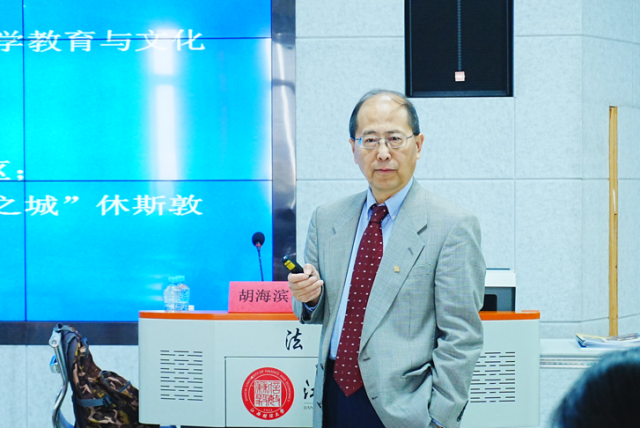
The warm winter sun shone upon the clear river, while sparks of wisdom illuminated the classroom. From December 1st to 4th, 2025, a transoceanic dialogue on jurisprudence conducted in Classroom Q402 of the School of Law (School of Discipline Inspection and Supervision) at Jiangxi University of Finance and Economics. Professor Robert Haibin Hu from the St. Mary's University School of Law in the United States was invited to deliver a four-day academic lecture titled Jurisprudence (Introduction to U.S. Intellectual Property Law), opening a window for students to glimpse the forefront of American intellectual property law.
Professor Robert Hu holds an LL.B. from Peking University, as well as an LL.M. and J.S.D. from the University of Illinois Urbana-Champaign. Having served as the Director of the Law Library at St. Mary's University for many years, he possesses profound expertise in intellectual property law, legal research, and comparative law. During the lectures, he unfolded the complex U.S. intellectual property system like a scroll: from cutting-edge disputes over copyright for AI-generated works, to the redefinition of trade secrets in the era of big data; from the intrinsic logic of the patent system in incentivizing innovation, to the challenges faced by the fair use doctrine in the digital environment. His explanations made complex topics accessible, featuring meticulous case analysis, distilled jurisprudential insights, and consistently interwoven with a comparative perspective against the backdrop of China's legal practice.
The course progressed through four core modules, each day focusing on a key area. When discussing the intersection of law and technology, Professor Hu noted: Law is not merely a collection of rules responding to technological change; it is a social contract that shapes technological ethics. He encouraged students to look beyond the letter of the law and contemplate the value balances and epochal questions underlying the institutions. This approach of penetrating phenomena to grasp essence deeply captivated the attending students.
The interaction sessions witnessed particularly lively intellectual exchanges. In response to a student's question regarding the forms and responses to future legal disputes in the context of Sino-U.S. economic and trade relations, Professor Hu offered analysis from dual perspectives of specific rules and macro-level governance. He foresaw that the focus of disputes would extend from traditional trade areas to new frontiers such as digital rules, data sovereignty, and standard-essential patents, emphasizing: True legal preparedness lies in cultivating a composite ability to understand the logic of different systems and engage in rule-making dialogues. He specifically recommended Essentials of Intellectual Property: Law, Economics, and Strategy as a key to understanding American law, describing it as concise yet profound, capable of helping to construct a clear intellectual framework.
At the conclusion of the lecture series, Professor Hu, with the sentiment of a legal educator, offered advice to the young students: The mission of legal professionals lies not only in resolving disputes, but also in participating in building a future of rules that is more just and inclusive. May you take Chinese rule of law as your foundation and an international perspective as your wings, finding your own course in the future skies of law.
The four-day course concluded with sustained applause, yet the ripples of reflection continued. Students gathered around the professor for further discussion, ranging from case research to career planning, in a vibrant atmosphere. This academic event not only imparted knowledge but also built a bridge connecting the legal wisdom of China and the West. As these young thinkers returned to their studies with newfound inspiration, a seed may have been planted in their minds—a deeper understanding of the rule of law, a keener perception of the times, and a broader imagination of their own future possibilities.
(Text by Song Chengle and Li Hui; Images by Zhang Hong and Yang Cheng)


