Your current location: Home>english>News>>News list
From 2:30 PM to 5:00 PM on October 19,2026, Associate Professor Stephanie Law of the University of Southampton, United Kingdom, was invited to our college to deliver a keynote lecture titled Artificial Intelligence, Regulation, and the Rule of Law in Classroom Q402. The lecture delved into the profound challenges posed by the rapid advancement of artificial intelligence technology to traditional legal values and social equity, and systematically analyzed AI regulatory pathways and legal frameworks from a global perspective.This lecture was hosted by Teacher Yang Xinlv from the Law School (School of Discipline Inspection and Supervision), with the participation of faculty and students from our college.
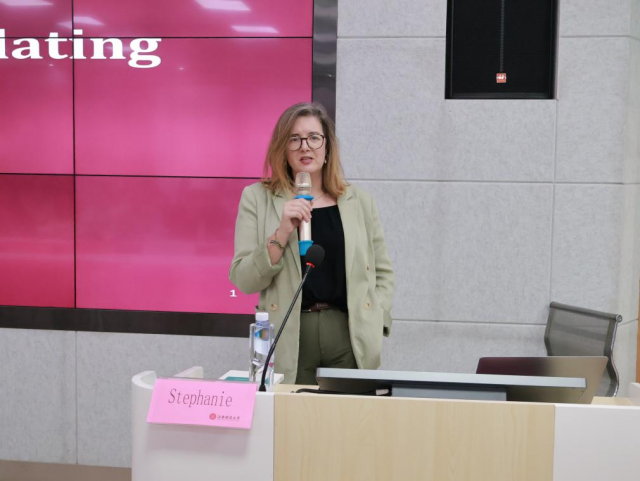
At the beginning of the lecture, Stephanie started with a classic case of AI recruitment bias : A certain company uses an artificial intelligence tool trained on resume data from the past ten years for recruitment. Due to the fact that male applicants are in the majority of the historical data, the AI system has developed a bias in self-learning. It not only prefers male resumes but also automatically lowers the scores of resumes containing female features such as those from women's sports teams and women's colleges. She pointed out that when individuals are rejected in the face of such black box decisions, how to question and who is responsible are precisely the core issues that the law needs to answer.
Based on this case, Stephanie proposed four key dimensions when the principle of the rule of law meets AI. First of all, there is comprehensibility. Laws must be clear and predictable, but the reasoning process of AI models is often like an invisible black box, making it difficult for even developers and users to explain the specific decision-making logic. Secondly, it is law rather than discretionary power. Legal rights should be determined by law and not be exercised at will by private companies, because automated scoring systems may hide errors that humans cannot review. The third is equality. Training data often magnifies the existing biases in human society, causing algorithms to solidify and re-pass on discrimination during iterations. Finally, there is the issue of accountability. When AI causes harm to individuals, whether to hold developers, deployers or the model itself accountable remains a legal ambiguity at present.
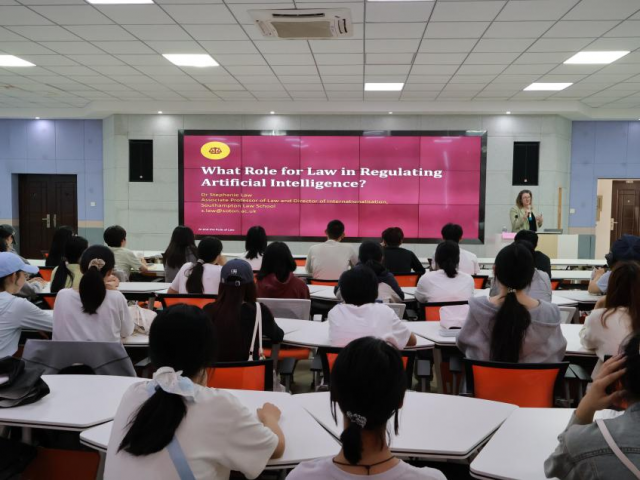
Stephanie expounded on the legitimacy of regulating AI from multiple dimensions in response to the urgent need for regulation. In addition to data protection involving a large amount of personal privacy, the application of AI in fields such as autonomous driving and autonomous weapons may cause substantial physical harm. Generative technologies such as deepfakes have exacerbated the spread of false information, seriously threatening the public's trust and participation in society. Furthermore, a few multinational giants control extremely powerful AI systems and their private rules. This self-regulatory model lacking public intervention is highly likely to lead to abuse of power. Therefore, the rule of law must step in and set clear boundaries for technological development.
When analyzing the regulatory model, Stephanie focused on introducing the EU's Artificial Intelligence Act. This bill adopts a risk-based tiered regulatory strategy: it comprehensively prohibits unacceptable risks such as social credit scores and emotion recognition. For high-risk applications such as recruitment, loans and policing, technical documentation, risk management and manual supervision mechanisms should be established, and strict compliance obligations should be imposed. For limited-risk applications such as chatbots, transparency disclosure obligations must be fulfilled. For instance, it is necessary to indicate that they are AI, and deepfakes need to be labeled. Low-risk applications, however, are only subject to existing legal constraints. At the same time, the bill is accompanied by a three-tier system of prohibitions, compliance obligations, and penalty enforcement. Enterprises that violate the regulations will be fined up to 35 million euros or 7% of their global annual turnover, whichever is higher. However, both the complex coordination process of the EU's unified legislation and the natural tension between the global flow of AI technology and the national application of law mean that the establishment of global standards still faces huge challenges.
At the end of the lecture, Stephanie broadened her perspective to cutting-edge ethical and legal propositions such as whether AI has consciousness and even whether it should be granted rights. Not only did she encourage everyone to think about these grand rule-making issues, but she also offered suggestions to the teachers and students present:In daily study and life, do not blindly believe in the content generated by AI. Instead, always maintain a spirit of questioning, frequently ask Why is the answer like this?, and actively advocate and understand the right to interpret the algorithm and the right to question decisions for yourself. This lecture integrates cutting-edge legal theories with technological practices, providing students with a clear framework for understanding the boundaries of the rule of law and regulatory challenges in the era of artificial intelligence. The lecture came to a successful conclusion amid warm applause.

Following the lecture, both the faculty members and the students remained deeply engaged, raising numerous questions—such as whether judges could utilize AI in drafting judicial judgments, and whether the advent of the AI era heralds the onset of the Fourth Industrial Revolution. Stephanie actively shared her perspectives with great enthusiasm, engaging in discussions with the faculty and students present.
After sharing her academic expertise and research interests, Stephanie also provided an overview of the University of Southampton in the United Kingdom, including its academic programs, admission requirements, and scholarship and grant systems. She encouraged faculty and students to pursue exchange visits and advanced studies at the University of Southampton, and shared her contact information to facilitate future collaboration between our university and the University of Southampton in areas such as scientific research and faculty-student exchange programs.(Text by Tan Piao and Yang Xinlv; Images by Tan Piao)


